вторник, 15 марта 2016 г.

Macrides, Ruth. “Dowry and Inheritance in the Late Period: Some Cases from the Patriarchal Register,” In: Eherecht Und Familiengut in Antike Und Mittelalter, ed. Dieter Simon.(Munich: R. Oldenbourg, 1992), 89-98.

Patriarchal registers are for the years 1315-1402, but biggest concentration is of years 1394-1401. Many cases concerned dowry and its restoration and protection against husband's creditors, authorisation of dowry's sale.
Diverse social standing of the litigants as well as divers content: jewellery, cash, utilities, vineyards, pounds, orchards, houses, workshops. "the anomaly and confusion of times" (2967, 3061, 3092, 3109, 3120, 3128, 3208, 3219) - Turkish siege of 1394 and struggles between John VII and Manuel II. The case about the income from the icon - 3219.
Many families left after John VII to Selymbria until 1399 - reclaimed properties. Not cared - low value of the property. Loss of documents.
Inconsistency in use of terminology: hypobolon (contribution of man to the marriage) and theoretron sometimes named, but more usual is the third of dowry. new term - proikanadochos - keeper of odwry, a relative of groom (if husband is under 25?). Vague manner of laws naming - the holy laws, neara (usually referred to Novel 26 of 1304-6 of Andronikos II and patriarch Athanasios) - tripartial division of husband's or wife's property if his/her death followed shortly by the death of children: 1/3  to spouse, 1/3 - to church for memorial services and 1/3 to grandparents. But in decisions the law often treated differently.
Dangerous to make generalizations, all cases are particular. Advantageous position of men - in 1317 the case of metropolitan of Antalya, who states that in his region men demand that some properties would be given to them as gifts, while others as dowries.
The hypobolon fall from equal in Justinian time, to 1/2 and 1/3 - burgman and Schmick. Proiks can be also a reference to man's dowry. In some cases it was of the same value, moreover, man can compensate from his dowry of the price of his wife's dowry dropped (3115 and 3122). The most common outcome of patriarchal decision is protection of woman's dowry. Proikanadochos - a new word for old practice. Variety of inheritance practices, sometimes dowered children do not participate in further share of property, sometimes they are suggested to collate, sometimes after death of parents other relatives add something to the dowry. 

среда, 17 февраля 2016 г.

Agne, daughter of Alexios Kallergis

During the last two decade preceeding the fall of the Empire in 1204, two brothers, Isaac II and Alexios III fought over the rule, and after Alexios won over his brother, another Alexios, son of Issac II brought his claims on the throne. Beeing persecuted Alexios (IV) fled to the Latins preparing a crusade and promised them someterritories in case they would have provided necessary support ruterning the Byzantine throne. That was the pretext for the following fall  of the City and the disaster of the conquest. However, according to Ch. Maltezou, Alexios IV himself fleeding to Boniface of Monferrat passed him the island as the reward. Therefore, when the lords of Latin Romania started to divide the byzantine lands, Crete was not considered among them. However, in 1204 Boniface of Monferrat sold the island to Venice for 1000 silver marca. And since than the Republic used an argument that the rights of the Byzantine emperor had now been transferred to the Doge (as one can find out from the message of the latin archbishop of Crete sent to the Doge in 1320) and the transfer was legitimate. After being taken by the Venetians the island was devided into 4 districts: Candia (Chandaka) Rethymno, Chania and Sitia, while the Rethymno district itself was devided into 3 castellania (Milopotamo, San Basilio and Amari) - (see Crete in 1563. Nautical map by Giorgio Calapoda). The highest authority on the island was Duke with 2 consiliari, these were representators of Venice, changed every 2 years, and lived in Candi. In the districts there were rectores having military and governmental powers.
The Castellani had to ensure the full equipment of soldiers, were obliged to inform their administrative center about penalties and fines being imposed and to keep records of the guards. They were forbidden to participate in food trade and Orthodox mysteries. Various boards with mainly advisory character, were established by the highest authorities: the Council of feudalism (Consilium Feudatorum), the Grand Council (Consilium Maius) and the Council for pleads (Consilium Rogatorum). The nobility and later bourgeoisie could send embassies to the capital with various requests, usually related vesting privileges.
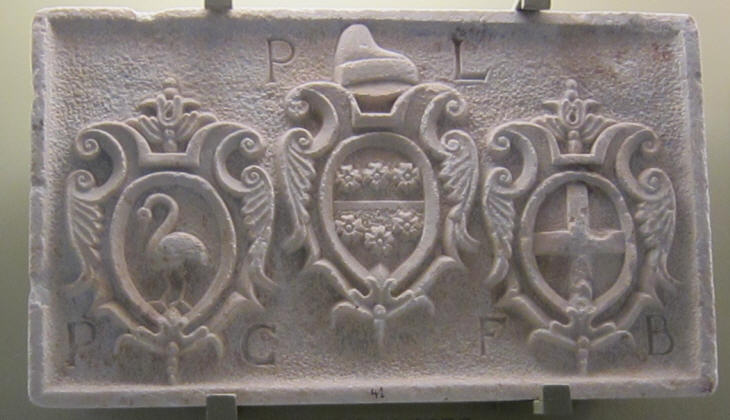
The highst power belong to the venetians (nobili veneti, feudati, "ευγενέστατοι άρχοντες και εκλαμπρότατοι αφέντες"), who were the new-comers and catholics and passed their titles hereditary (see - Historical Museum of Iraklion (Candia): coats of arms of local Venetian magistrates at the sides of that of Doge Pietro Loredan (1567-70)). The greek nobility was subordinated, but according to the legend it derived from 12 archontopoules sent by the Byzantine emperor  to Crete under"kyr Phoka" . Cretan Greek nobility considered the Byzantine emperors to be the only legitimate source of power, which is reflecte for example in mentioning the Byzantine rulers in the dedicatory  inscriptions in the churches built during the Venetocratia.
City dwellers, who were not nobles, were called citizens or bourgeois (cittadini, burgenses). This class consisted of civil servants and professionals. To the lower social rank belonged the people of the cities and the countryside (plebe, populari or populani, villani or contadini). The villagers were divided into unwritten (agrafi), freedmen (franchi) and paroikoi (villani parici), working on the public or private land. Villagers paid taxes (akrosicho, kapniko) and was forced to execute supplementary taxes in goods such as kaniskia. Unlike them the "tsitadinoi" were free from the taxes in nature. They had the obligation of military service, paying little tax and giving accommodation to the foreign mercenaries serving in Crete. The heaviest natural tax was working for galleys. Many times those who were appointed to this works were forced to flee to the mountains to avoid it or to sell their property to pay for replacements. Most Cretans belonged to the class of paroikoi.
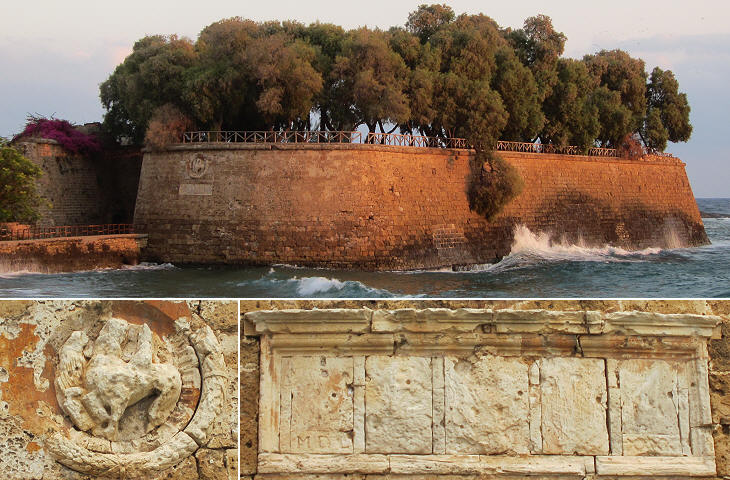
The interests of the Italian Republic were focused mainly on the beneficial geographical location of the island on the crossroads of Mideterranean sea-routes, and therefore the majority of the Venetians inhabitated the sea-side towns and lands (see - Bastione Sabbionara of Candia and a winged lion and erased 1590 coats of arms of the Venetian officers who promoted the construction of the bastion).
Dowries were inherited according to juxta usum GraecorumShared memory of Byzantium was used by local archontes as a propaganda tool strengthening their prestige, increasing their influence and formed strong bonds with the population
According to catholic priest and traveller Christoforo Buenodelmonti (1415), the archontes had important roles and were represented as having received their power from time of Byzantine appointment, these were several families, who were intermarried, lived separately from the Venetians, used Greek, had Greek titles. The rural areas were predominantly Greek (rura Romeorum) and an archon was their only connection to the Venetian authorities. 
In this circumstances, the life of the local rural Greecs was changing slowly and preserved continuity with the Byzantine epoch.
In 1283 on Crete the biggest revolution of the Cretan aristocracy against the Venetians began and it was led by powerful archon of Mylopotamos(see the photo) Alexios Kallergis. He tried to compel the Venetians to cede to him privileges and to recognize the independence of this territory. He knew very well that the independence of Crete was impossible and the union with Byzantium also impossible. He secured the support of many noble families, paroikoi and the clergy and began to make small-war attacks (guerilla), which exhausted the Venetian forces. He quickly became a master of Western Crete and for ten years he followed the same tactic. At the same time Venetians and Genoese broke out. Both, the Genoese and the Emperor Andronikos II sought help of Kallergis. So, Kallergis decided it was time to pose his demands to the Venetians. So he turned to capitulation which resulted into the agreement of 1299. With this the Venetians recognized the ruling position of Kallergis in exchange for the oath of loyalty and obedience to the Venetian state. Kallergis returned his land and even received some more. The Republic satisfied all his demands: he could keep horses, release paroikoi, move freely in the cities and fortresses and to accept kaniskia. Kallergis acquire the right to manage the state monasteries and that of of the Latin Patriarchate and the dioceses Mylopotamo. He might install in the area of Arios a Greek bishop. Cretans were entitled to go out of Crete to be ordained as priests, deacons and their children, if they were paroikoi, were not "diakratimenoi paroikoi." The treaty with Venice of Allexio Kalergis was beneficial to all Cretans, lords, clergy and paroikoi. The 1381 Venice bestowed the privilege usually given to the Venetian nobility to Alexios’ son, Georgios Kallergis.

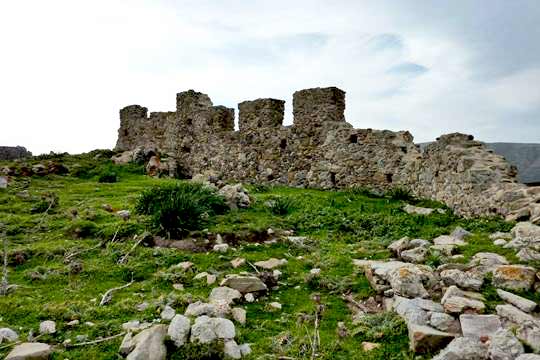
Agne was the only legitimate daughter of Alexis Kallerges (Kalergis) and Eirene Skordyle. She was born in Kastri, above the town of Mylopotamos and spent there most of her life. At the time of her birth, the 13th century, Kastri was a center of the rebel movement headed by her father against the Venetians. At that time the village had its castle called Apanokastri (see above and below- now archeological remains in Paliokastro, Kastri) with a church of Panagia, which is still present next to the castle (close to so-called pyrgos of Kallerges). Unfortunatelly the church didn't preserve its murals, but the remnants of Kallerges' coat of arms are visible on the eastern part of the building's exterior.
Agnes was born somewhere around 1299 when her father signed the reace treaty with the Venetians. She was married to Jakobos Kornaros, a Venetian Cretan, who bore a nickname Kornaraki witnessing about his rather small stature. her husband for the first time appear in the documents 1328, but without mentioing Agnes.
What was so special about this Cretan lady? Almost nothing, except the fact that one can read her last will dictated to the notary on 9th February of 1331. So, 10 years past since the death of her mighty father, and now feeling herself ill, she decided to take care about the postmortem arrangements "seeing dedath approaching". So, she wrote her will in Latin, or more precisely, the notary was venetian, and therefore the will was in Latin.
Agnes bequeaths to her husband Jacobos Cornaro most of her dowry and all other movable and immovable property. Some other sums went to churches and more distnt relatives, including two sisters. The balance sum of splits in churches, the monastery of Sinai and various relatives.
Her parents were buried in St. John church in Mylopotamou and she bequeathed 30 heperpyra to bishop Makarios (episcopus Graecorum), Itemdimitto episcopatui Milopotamensi ubi sunt sepulti mei parentes et mortui mei

Agnes didn't live long after writing her will. In 1333 protopapas Costas Vergitsis (Κώστας Βεργίτης ) gives a receipt to Agnes' husband assuring him that he collected money from the testament and that they ought to be spent for executing the will of the deceased  Agnes at the church of Virgin of the village Kato Kastri in order to comemorate her.
Bibliography:
Maltezou, Chryssa. “Byzantine 'Consuetudines' in Venetian Crete,” Dumbarton Oaks Papers 49 (1995): 269–280
Μαλτέζου, Χρύσα Α., "Η Κρήτη στη διάρκεια της περιόδου της βενετοκρατίας (1211-1669)," in: Κρήτη: Ιστορία και Πολιτισμός, ed. Ν. Μ. Παναγιωτάκης, εκδοτική φροντίδα «Βικελαία Δημοτική Βιβλιοθήκη», Vol. 2 [Σύνδεσμος Τοπικών Ενώσεων Δήμων και Κοινοτήτων Κρήτης] (Crete: 1988): 105-161
http://www.kallergis.info/
http://kallergides.blogspot.hu/
McKee, Sally.  Wills from Late Medieval Venetian Crete, 1312-1420 (Dumbarton Oaks, 1998), vols. 1-3.
McKee, Sally. Uncommon Dominion: Venetian Crete and the Myth of Ethnic Purity (University of Pennsylvania Press, 2010)

понедельник, 15 февраля 2016 г.

http://varalis.blogspot.hu/2009/12/2.html

Πριν λίγο καιρό είχα γράψει για το μοναστήρι Παναγίας Χρυσίνου και τον π. Ιωάννη. Ηταν πολλά τα τηλέφωνα και τα mail που δέχτηκα κι είπα να βρω την ιστορία του μοναστηριού:


Δύο χιλμ. περίπου από τα Αμπέλια (παλιά Καρούτια) του Κλεινού, και πάνω στον αμαξιτό δρόμο για Κλεινό - Χρυσομηλιά κ.λ.π., βρίσκονται τα Χάνια του Σαμαρά, με 7, μόνο, οικογένειες, σήμερα, περίφημο, άλλοτε, στέκι στη βλαχόστρατα του Ασπροπόταμου. Εδώ τοποτετείται το παλιό Χρύσινο (Χούρσινου το έλεγαν οι ντόπιοι), βυζαντινός οικισμός, στην περιοχή του Κλεινού. Εδώ υπήρχε το βυζαντινό μοναστήρι Παναγία του Χρυσίνου ή Χρυσένου ή Χρυσίνι.

Η χρονολογία της ίδρυσης. Ο ιερομόναχος Μακάριος (Μανασσής).
Πότε ακριβώς ιδρύθηκε η μονή, δεν είναι γνωστό σε μας. Οπωσδήποτε, όμως, υπήρχε τον 14ο αιώνα. Στα 1346-1347, μόναζε, εδώ, ο ιερομόναχος Μανασσής. Αυτός, αφού συγκέντρωσε αρκετά χρήματα για τα έξοδα, άφησε τους άλλους συνασκητές του και πήγε στα Μετέωρα, στην σπηλιά του Πασχάλη, τον οποίο και διαδέχτηκε: <<...διεδέξατο την μικράν εκείνη κατοίκσιν [του Πασχάλη], ιερομόναχος τις, Μανασσής λεγόμενος, όστις ην, εν τη του Χρυσένου μονή, μετά των μετ’ αυτού εάσας ουν εκείσε τους αδελφούς αυτού, λαβών δαπάνας, και έξοδον, ανήλθε εν τω σπηλαίο και εύπορων, ηύξησέ τε τούτο και έστερέωσεν και προσευχάδιον μικρόν κατεσκεύασεν...>>
Εκεί, ο Μανασσής <<έλαβε και αυτός τόπον εκ του Στύλου και εφύτευσεν μερικόν άμπελιον>>, μετονομάσθηκε σε Μακάριο κι έφινε αρχιμανδρίτης της σκήτης των Σταγών (Δούπιανη). Τον συναντούμε στα μέσα του 14ου αι. να υπογράφει σε κάποιο σιγνογραφικό γράμμα ως εξής: <<Ο εν ιερομονάχοις ελάχιστος Μακάριος αρχημανδρίτις και καθηγούμενος τις σεβάσμιας μονής τις υπεραγίας Θεοτόκου και επικαικλημένης Δουπηάνεως υπέγραψε>>.
Ο Ι. Βογιατζίδης τον βρήκε και σε μία ανέκδοτη και αχρονολόγητη διαθήκη του Μανουήλ Ιωαννάκη, που σώθηκε σε αντίγραφο, σε κώδικα της μονής του Ρουσάνου, του 17ου αι. Η διαθήκη αυτή συντάχθηκε <<κατενώπιον του τε κυρού Μακαρίου και αρχιμανδρίτου και του πανυπερσεβάστου και κεφαλής Σταγών κυρού Θεοδώρου του Ορφανοιωάννου και των εντιμότατων κληρικών της αγιωτάτης επισκοπής Σταγών>>. Κατά τον Βέη, ο ιερέας Μανασσής, που μνημονεύεται, στα <<Πάτρια ήγουν εξήγησης πέτρας της λεφομένης Υψηλοτέρας...>> μπορεί να ταυτιστεί με τον κτήτορα του κώδικα 302 του Μετεώρου, όπου στο φ. 1α έχει γράψει: ταπηνού: θίτου Μανασσή>>.
Τέλος, ο Μακάριος, με παραδοτικό και διαθηκώο γράμμα, άφησε το αμφισβητούμενο μονύδριο της Θεοτόκου στο Πηγάδι στον άγιο Αθανάσιο τον Μετεωρίτη. Από δω φαίνεται ότι ο Μακάριος ήταν μεγαλύτερος του Αθανασίου.
Αλλά ο Μανασσής – Μακάριος <<μετά χρόνον τινά, εάσας το σπήλαιον, απεστράφη όπισθεν εις το Χρύσινον>>, όπου, πιθανότατα, πέθανε. Ο θάνατός του σημειώθηκε, οπωσδήποτε πριν το 1388, μια και στον ορισμό του καίσαρα. Αλέξιου Αγγέλου, της χρονιάς αυτής, αναφέρεται ως <<μακαρίτης>> πια.
Το προσωπικό της μονής
1346-47: Μακάριος, ο πρώην Μανασσής. Πέθανε πριν το 1388.
1740-41: Αγάπιος, ιερομόναχος, ο κτήτορας της μονής, και Ιωσήφ, μοναχός
1800: Νικόλαος
1825: Καλλίνικος και Κύριλλος
1881: 6 ενδιαιτώμενοι μοναχοί
1888: 3 μοναχοί, 2 μοναχές, 4 δόκιμοι άρρενες και 3 υπηρέτες
1889: 7 κάτοικοι: 6 άρρενες και 1 γυναίκα
1895: Ευγενία και Θεοδοσία, μοναχές. Άνθιμος, μοναχός. Νίκανδρος Κωνσταντίνου και Κωνστάντιος Παπαβασιλείου, ιερομόναχοι. Κωνσταντίνος Γεωργίου και Αποστόλος Παπαβασιλείου, δοκίμοι.
1895-1904: Θεοδοσία, υπέργηρη
1895, 1904, 1908, 1910-1911: Κωνστάντιος Παπαβασιλείου, ιερομόναχος. Πέθανε την Κυριακή 4.9.1911.
1896: 5 κάτοικοι
1897, 1904-07 και 1914-17: Βενιαμίν Σακαλής, ηγούμενος
1901: 5 κάτοικοι
1904: Βενιαμίν Σακαλής, ηγούμενος. Κωνστάντιος Παπαβασιλείου, ιερομόναχος. Γαβριήλ Ευσταθίου, απουσιάζοντος προ καιρού. Ιγνάτιος Σουμαρούπα, εγκατασταθέντος προ μηνός εν τη Μονή. Θεοδοσίας μοναχής, υπεργήρου. Μίας κανδυλαναπτρίας εις τον ναών του Μετοχίου. Εωός υπηρέτου, ενός αιγοβοσκού και ενός αγελαδοβοσκού, εξ ων μόνον ο αιγοδοσκός ούτε διατρέφεται ούτε θποδύεται.
1906-07: Ανανίας Γκίνης, ιερομόναχος - τον προσκάλεσε η μονή, από τη μονή της Πεντέλης, ως σύμβουλό της - και Κάλλιστος Καλαωτώνης - προσκλήθηκε, με τον Ανανία της Πεντέλης, από τη μονή των Ασωμάτων – Πετράκη, ως σύμβουλος.
1906, 1908-11, 1913-15, 1917: Νικόδημος Ιωάννου ή Κουτσογιαννάκης, ιερομόναχος
1907: 7 κάτοικοι. Βοσκός ο Βας. Αναγνώστου και αγελαδοβοσκός ο Χρ. Μπούκας, σύμφωνα με το αρχείο της μονής.
Μετέφερα και τα ονόματα των ανθρώπων που έμειναν σε αυτό το μοναστήρι. Προβληματίσθηκα από κάτι που ένας φίλος ανέφερε. Στην πραγματικότητα ο π. Ιωάννης αναστυλώνει την ελπίδα όλων αυτών των ανθρώπων. Γιατί οι εκκλησίες και τα μοναστήρια δεν είναι απλώς κτίσματα είναι κατοικητήρια της ελπίδας των ανθρώπων αυτών που πέρασαν και αυτών που έρχονται. Το γεγονός οτι κάποιος προσπαθεί να επαναφέρει αυτόν τόν τόπο της ελπίδας μέσα σε μια εποχή που προκαλεί μόνο ερείπια και σκουπίδια, το θεωρώ μοναδικό γεγονός.
Μου είπε ο π. Ιωάννης και το μεταφέρω, οτι εμφανίσθηκε ένα site με τα στοιχεία του μοναστηριού έχοντας και έναν αριθμό λογαριασμού. Το μοναστήρι και ο π. Ιωάννης δεν έχουν καμμιά σχέση με αυτό. Ο π. Ιωάννης δέχεται τρόφιμα, που τα πηγαίνει σε κάποιους ηλικιωμένους. Δέχεται πέτρες για να φτιάξει το μοναστήρι. Ανάγκη χρημάτων δεν έχει. Εχει αρκετή ελπίδα γιατί δεν διάβασε για το θαύμα το έζησε και το ζεί, συνεχώς.
Κι αν τον αναφέρω συνεχώς και τον σκέπτομαι είναι για έναν λόγο. Υπάρχουν άνθρωποι που έχουν διαβάσει πολύ για τον Θεό. Εχουν περάσει μέρες και ώρες και χρόνια διαβάζοντας για τον Θεό. Προσπαθούν να τον πλησιάσουν με την λογική, με τις αναφορές σε βιβλιογραφία και άλλα όσα ο νούς επεξεργάζεται. Σε αυτή την κατηγορία είμαστε οι περισσότεροι. Και υπάρχουν άνθρωποι που τον έχουν συναντήσει. Σε αυτή την κατηγορία είναι ο π. Ιωάννης.

Τον αναφέρω λοιπόν γιατί έχουμε συνηθίσει να βλέπουμε αυτό που έχουμε μέσα στο μυαλό μας και ζούμε σε μια εποχή που όλα έχουν γίνει αντικείμενο αγοροπωλησίας και μόνο αυτή βλέπουμε σε κάθε προβολή και πράξη. Τον αναφέρω λοιπόν ως ένα παράδειγμα ανθρώπου που πιστεύει οτι η προσευχή και οχι η επανάσταση μπορεί να αλλάξει τον κόσμο.


Sophianos D.Z.Ἡ ἀνέκδοτη διαθήκη τοῦ Μανουὴλ Ἰωαννάκη (μέσα ΙΔ' αἰ.) καὶ ἄλλα κείμενα σχετικὰ μὲ τὴ μονὴ τῆς Θεοτόκου στὸν Στύλο τῶν Σταγῶν Ἡ ἀνέκδοτη διαθήκη τοῦ Μανουὴλ Ἰωαννάκη (μέσα ΙΔ' αἰ.) καὶ ἄλλα κείμενα σχετικὰ μὲ τὴ μονὴ τῆς Θεοτόκου στὸν Στύλο τῶν Σταγῶν

четверг, 11 февраля 2016 г.

Economic collaboration of byzantine peasants

Fotini Kondyli. "Changes in the structure and wealth of the Late Byzantine family," In: Approaches to the Byzantine Family S. Tougher and L. Brubaker (eds) (Aldershort; 2013), pp. 371-390
Changes in structure of property from the 13th to the 14th century, issues of mobility, cooperation and alternative economic activities. On the basis of acts of Lemnos (Lavra 1284 - no. 73 and 1304 - no. 99). In fascal lists one can see a domination of nuclear family of 2 persons, sometimes 3, in 1304 act les and less those families who had more than 3 members - this is a fiscal strategy.In land ownership - majority had any, so some and more services (millers, shoesmakers etc.), vineyards and ship owners. Changes in family economic strategies and property ownership. Economic collaboration and common use of property inside of family. Property owned not jointly, but in shares, it is pooled together for common tasks.After mid-14th century depopulation (maybe coz of haevy taxes and Black death). Increase in ownership of paroikoi - Lavra 1361 (no. 139). Huge increase in family ownership.  This change made paroikoi not to have commonly shared property and extended family, coz land is available.Changed an inheritance pattern.So, in 1284 act the bigger family than walthier. More ships, more lands. If children could extract some property from parents, they could register as a separate fiscal unit, though they stil owned jointly some parts.Lefort, 1985, 1986 - many population, not many arable lands led to migration to more margin and less inhabited areas.it also could lead to change of activity, staying at parents' house.In well populated villages more children and more families (so, they divide more), less populated villages have smaller families and no relations with each other, so they could be newly inhabited (see lefort, 1985-6 describing this resettlement strategy).in act of 1304 there is a number of males, who registered with their fathers-in-law, and not with their fathers (reffered as son-in law). fortunes of 2 families were connected. These men could be from another place, who settled with their new families in the village.Many references to abandoned lands - peasant's mobility. but this mobility comes from helmets, cultivated lands, but not abandoned villages.
In the end of the 14th - b. of the 15th majority of families in the acts were nuclear with distinct possessins and obligations from the extended. Monasteries relocated the peasants to revive areas (Pantocrator, no. 20, 140-145).
Jacoby 1962 - increased peasants' mobility in Macedonia in the end 14-b. 15th.
Family roles depended on property' ownership. In extended family young mles in their decisions were depended on the older members.
If peasants were taking abandoned lands belonging to their extended family they actully strengthened their ties. 

Question of common rituals with members of extended and immediate family? So, social, not economic ties (networks) became wider. Changes in property management.


A. Laiou, “Family Structure and the Transmission of Property,” in A Social History of Byzantium, ed. J. Haldon, 51–75 (Chichester, 2009)

Family and transmission of property. Family is a mian production unit ofr agrarian societies - in byzantium it is peasant household. Kinship was up to 7th degree
Family property consists of material goods + symbolic capital (networks, reputation, social status) . Byzantine system was based on partible inheritance.
Studies on trnsmission of property can be based on legal or narrative sources. - disjunction of leglislative norms (Roman) and customs (Hellenic).
Issue of dowry as finale or augmentable in future inheritance mode - Beaucamp 1998; Cheynet 1998; Laiou 1998; Lefort 1998
Question of the rights of political and ecclesiastical powers over the inheritance of people dying without heirs and without a testament - Karpozilos 1979; Nakos 1988; Tourtoglou 2000; Laiou 2000: 114–20
Whether the state ruled on the matter of the transmission of property differently depending on the status of the affected individuals (dependant peasants or not).
 Laiou 1992: chap. 1. - matrimonial strategy of artistocracy which became since the 11th century closely linked to each other through multiple marriages and created the network of alliances.In Komnenian time the role of women in lineage rises, so Alexios Komnenos married Irene Doukaina - alience of families. So, starting from Komenian time "women were transmitters of both lineage and property." 
Laiou has changed her point of view since 1977 (Peasantry Society in the Late Byzantine Empire), when she traced through the indices of patriarchy the fact that the names and relationships passed through male line. Later she noticed that discendants through female line did occur. So, starting from 14th c. about 20% of households were headed by widows. Usual household is either a nuclear family or 2 families (parents and child's family). But extended household is present, especially in areas with Slavic names. (reference to Laiou-Thomadakis 1977, 78ff).
According to law, without a testament all children receive the equal share. Usually, however, the children received their portion at the moment of marriage, so the parents had greater freedom with what has left - Connection of property transmission and matrimonial connections. Exemplified with the will of Karabas (Chilandar no. 30, 1314), who made a testament after ditributing to children their shares, so he left to church, 2nd wife, godsons etc.
Aristocracy's strategies to fight defragmentation (since close marriages are forbiden as well as primogenitura). Cheynet thinks that ladies could receive a large part of their dowry in cash and jeweleries, not to divide the estates (Cheynet, 1998), but out of Peira is visible that women also got property.Secondly a good marriage was also a capital - so, importance of marriage stategies. Good material for 13-14th c. of patriarchal registers and Chomatianos - people invented strategies to diminish the conflicts inside a family. There was a law of returning a dowry for further redistribution after parents' death, and it was known, but according to custom all children who got marriage gift were excluded from inheritance, heirs - who didnt leave the household with marriage gift.
Peasantry's strategies. They also practiced the equal partition. But sometimes the eldest son might receive preferential treatment. For peasants selling their lands was introduced a preemption right (first buyer should be a relative). Patrimony was a form of family bond.

Some bibliography: 
Patlagean. Pauvreté économique et pauvreté sociale à Byzance, 4e-7e siècles 1977

Laiou-Thomadakis 1977: 90–4. - wome became the heads of households when widowed.
J. Lefort. "Radolibos population et paysage,” TM 9 (1985): 195–234
Τόνια Κιουσοπούλου. Οι "αόρατες" βυζαντινές πόλεις στον ελλαδικό χώρο (13ος-15ος αιώνας) (Αθήνα: Εκδόσεις Πόλις , cop. 2013 orig. 1990) - on inheritance, dowry could be like an equal share
Cheynet “Aristocratie et héritage (XIe–XIIIe siècle) G. Dagron and J. Beaucamp (eds.), La transmission du patrimoine (Paris): 53–80
Marc C. Bartusis. "Exaleimma : Escheat in Byzantium," Dumbarton Oaks Papers 40 (1986): 55-81 - On exaleimmata - he thinks that exaleimmata in late Byzantium were non-owned lands as a consequence of their owner death without heirs. While many abandoned lands wer owned by monasteries, landlords or even paroikoi.

The cave hermitage of St. Gregory Meteora

To left and a bit above over monastery of St. Anthony, at a height of forty meters one can find a 3-caves hermitage of St. Gregory. Founders are saints brothers-monks Gregory and Theodosios. The small monastery consists of three, or perhaps more, superimposed cave habitats, old ascetic caves, supplied with typical wooden terraces (the first situated at a height of about 25 meters, the second 35 and the third at a height of 40 meters).
This area is not affected by rain, because it is situated under an acute angle toward the rock surface. This way the wooden terraces survived and even, partly, the ladder.
Writing about this place Athanasius Tsagkarsoulis noted: "In the same rock massive and in a short distance from St. Anthony St. Gregory is located (...). Today one can see the wooden frames of the cave entrance, wooden columns and hanging wooden ladder, dated back to about 600 years."
The chapel was decorated with medieval frescoes, relatively well preserved. The fathers Meteorites came to the hermitage in the early 70s and then firstly discovered the frescoes of the holy founders, supplied with their names and the tombs of the founders brothers-monks (aftadelfoi) Gregory and Theodosios, which were carved in the church. The meteriotoi also found an icon of Hodegetria made on leather and a 14th century deisis icon, which is kept now in the Great Meteora Museum.
The cavernous chapel is oriented south-east, and its three sides are built of stone and one is resting on the rock. Gojko Subotić recently identified the church of the Assumption with the Virgin “para to Pigadion” (παρά το Πηγάδιον) connected with Archimandrite Makarios appeared in the testament of Manouel Ioannaki.
In the sanctuary, the altar is carved in the rock. In the conch of the apse the Virgin Mary in the type of Oranta with Jesus Christ on her chest (often identified as Vlachernitissa) is depicted.
In apse one can see the Melismos with the half-figures of two officiating hierarchs, namely Basil the Great (left) and St. John Chrysostom (right). On either side of the apse niche, the Annunciation is situated, the Archangel Gabriel (left) and Mary (right). Left from the Archangel the half-figure of St. Stephen protodiakonos is placed on the northern wall. Respectively, on the right of Mary St. deacon Romanos on the southern wall faces St. Stephen.
In the area of ​​the sanctuary, on the southern wall, holy bishops are depicted in two zones, namely: St. Cyril of Alexandria and St. Athanasius the Great in the upper zone, and respectively, St. Gregory the Theologian and St. Blaise in the lower zone. On the arch of the conche of the sanctuary the traces of inscription, written in large letters, now illegible, are still visible.
In the nave, on the north wall the composition of the Dormition is situated, and below it one shrine of the founder is carved. Above the Dormition, on the semi-vault going down to the northern wall of the church one can see the Transfiguration of Christ.

Similarly the other semi-vault, descending to the south wall, is occupied by the Descent into Hell (= Resurrection of the Lord), and in the lower zone of on the southern wall St Nicolas (a big half-figure), Saint Panteleimon and the holy Anargyroi Kosmas and Damianos (full figures).
Above the entrance on the west wall there are three female saints: St. Marina, St. Anastasia Pharmakolyptria and St. Paraskeve. On the right inlet on the west wall there is prophet Daniel, while on the left inlet on the west wall, basically above the tomb of the founder, one can find the Myrrh-bearing women at the Tomb of Christ with the angel.
This way, the whole program of the small chapel has funerary subject, while the Dormition placed above the first grave depicts the moment of the ideal death, similar to sleep, witnessed by Apostles and bishops and accomplished through taking to the heavens, the scenes of the Descent into Hell and Myrrh-bearing women at the Tomb of Christ are promises of future resurrection. Simultaneously, the placement of Daniel in the same zone reminds about the Last Judgement and the Kingdom of Christ (Daniel: ch. 7-12). While presence of holy doctors can be understood both ways, they are protectors of human health, but also healers of human souls. The rest of the program has liturgical meaning, namely the scene of transfiguration, figures of the officiating bishops and the Virgin with the Child witness and symbolize the mystery of Christian service. Therefore one can assume that the chapel was intended for burials and commemorative services at the time it was painted.
The outer west wall of the chapel, flanking the entrance, holy Theodores (on the left) and the archangel Michael (on the right) are depicted. next to Sts. Theodores, left from the entrance is the second tomb.
The outer southern wall has two registers; from the down part of the window up are St. Demetrios, St. George and the Deisis (Christ, Mary, John the Baptist). In the lower zone one can see the great ascetics of the Church: Anthony, Euthymios, Arsenios, John Klimakos, Pachomios, Ephrem the Syrian, Theodosius, Onoufrios and Makarios. On the eastern part of the exterior southern wall there are portraits of the founders, brothers-monks Gregory and Theodosios. In the same place with the founders there are following inscriptions:

1) Δέησις του δουλου του Θ(εο)υ Γρηγορηου αμαρτολού κε κτήτορος. Μνήστητι Κ(υ)ριε τον γονέον μου Μανουήλ· ϊερέος· κα(ι) της σ(υμ)βήου αυτού Άνης κα(ι) τον ται (=τέκνων?) αυτώ[ν].

2)  Δέησις του δούλου του Θ(εο)υ Θεοδοσήου ηερομονάχου.

Gojko Subotić also informs us about the dedicatory inscription placed above the entrance to the church, which gives the dating with 6883 (1374-75):
† Ανηγερθην ο θήος κ(αι) πάνσεπτος ναος ουτος της ηπερεβλογημέν[ης] δεσπηνής ημόν Θεοτόκου· δια κ(αι) (ε)ξόδου Γρηγορηου αμαρτολο[υ] [κ]τήτορος· μετα του αυταδέλφου Θεοδοσήου· ϊερομοναχου αρχϊερατέβοντος Ματ[θέου] της αγηοτάτης επησκοπης Σταγΐων [͵ϛωπ]γ  ἰν(δικτιώνος) ιγ
According to Subotić, who reconstructed the unpreserved date, one of the special characteristics of this inscription is the absence of the higher authority mentioned (as it was a bit earlier, in 1366-67, in Ipapante-Υπαπαντής monastery, where as a higher authority the king Simeon Uroš is referred). The reason for this is that the son and successor of Simeon, Jovan Uroš, already in late 1372 or early 1373, retired to the monastery of the Transfiguration, the Great Meteora, as monk Ioasaf. Finally, the proposed date agrees with the style of the frescoes. Along with the remains of frescoes in the chapel of St. Anthony in St. Nicholas Anapafsas (Αναπαυσά), and especially with the well preserved representations in the eastern part of the three-aisled church of Panagia Kastraki, their style indicates that the décor fo the cell of St. Gregory belongs a broader set of painting of that era.
Serbian Byzantinist assumes the possibly that the second founder, Theodosios, was also founder of namesakes cave monastic house of St. Theodosios in Gavros of Kalambaka, because its church has well preserved remnants of mural belonging to the 14th century. However, we have no written evidence that the cave church of St. Theodosios in Gavros with existing cells belonged to the monastery of Doupiani or the cells of the Great Meteoron.
Nowadays the caves are inaccessible without special alpinist equipment.

Video of the skete, between mins. 12.34-15.35  the monk shows some frescoes inside the church.

Bibliography:
http://meteoritikoiantilaloi.blogspot.hu/2014/05/blog-post_26.html
 G. Subotić, «Počeci monaškog života i crkvi manastira Sretenja u Meteorima», ZLU 2 (1966), 125-. 181
G. Subotić, "Η τέχνη των βυζαντινοσέρβων ευγενών στην Ελλάδα κατά τις τελευταίες δεκαετίες του ΙΔ αιώνα," in: Byzantium and Serbia the 14th Century (NHRF/IBR, International Symposium 3), Athens 1996, 169-179.
G. Subotić – I. Simonopetritis, L’iconostase et les fresques de la fin du XIVe siècle dans le monastère de la Transfiguration aux Météores, in Actes du XVe Congres International d’Etudes Byzantines, Athènes –Septembre 1976, II Art et Archéologie – Communications B, Athènes 1981, 751-758

среда, 10 февраля 2016 г.

St. Nicholas monastery in Malagari near Perachora

Η Ιερά Μονή του Αγίου Νικολάου του Νέου στο Μαλαγάρι

The chapel is situated in Malagari near Perachora (Περαχώρα), periphery of Corinthos, built in the  11th century. It is a single-spaced type church with compact dome and three-sided apse sanctuary. Newer repairings have caused great changes the appearance of the monument and the old cells on the west.

In the 13th century the western aisle was added to the church with 2 arcosolia. The standing deisis is situated in the northern arcosolium, here the Virgin and John the Baptist addressing Christ "Photodotes," while the Virgin also introduces to her Son a monk with a long white beard. The monk turns to Christ with prayer and a scroll in his left hand. Inscription: παρομηοθη(ς) Σοφρονηος μοναχος ο καλοζοης [παρμοιωθης Σωφρονιος μοναχος ο Καλοζώης]. On the introdos of the arcosolium two female saints are located - St. Eirene and St. Cathrine, both dressed in imrepial clothes.
The southern arcosolium  is occupied by the Dormition scene with a developed iconography, including Dionysios serving with a censer the at the bed of the Virgin and St. John the Theologian touching her face. There two saint Theodores on the introdos, at the feet of Theodore Teron one can see another monk, younger in age, holding in his hands the feet of the saint and addressing him with prayer. The Inscription: ο παρομηοθης Δηονισηος μοναχος καλοζοης [ο παρμοιωθης Διονύσιος μοναχος Καλοζώης]. Probably, the choice of the iconography is motivated by patron function of Sts Theodores for the region - the palladium icon of the saints was kept in the church of Hagioi Theodoroi in Corinth - Demetrios Athanasoulis, "Corinth," In: Heaven and Earth. Cities and Countryside in Byzantine Greece Albani, E. and E. Chalkia, eds.,  (Athens, 2013), 206-207. Moreover, the Dormition scene also has a distinctive feature motivated by the patron's choice, namely presence of St. Dionysios the Areopigite among the apostles. As it was noted by Ch. Walter the presence of only one bishop at the Dormition scene is rare, they either appear in the group of three or do not appear at all (Walter, Christopher. "Three Notes on the Iconography of Dionysius the Areopagite," REB 48 (1990): 260). Besides, Dionysios and St. John are the only once whose names are inscribed in the scene. 

Possibly these two monks having the same surname were father and son, as it was suggested by Eleni Ghini-Tsofopoulou ("6η Εφορεία Βυζαντινών Αρχαιοτήτων. Χρονικά" Αρχαιολογικό Δελτίο 36/2 (1981):173-174).
However, the absence of beard, the beads on the neck of Dionysios and his clothes (dark brown robe, black cap and white cloak) make me think that this one might belong to a catholic order (carmelites?)
 " Άγιος Νικόλαος Βρίσκεται στην περιοχή Μαλαγάρι πάνω σε ύψωμα με μαγευτική θέα προς τις Αλκυονίδες, άλλοτε καθολικό μικρού μοναστηριού (Π ί ν. 107 α).Είναι μονόχωρος με τρούλο συνεπτυγμένου τύπου με τρίπλευρη εξωτερικά αψίδα Ιερού. Νεότερες επισκευές έχουν προκαλέσει σε μεγάλο βαθμό αλλοιώσεις στην εμφάνιση του μνημείου και των παλιών κελιών στα δυτικά. 
Ενδιαφέρον παρουσιάζουν για την ποιότητά τους οι σωζόμενες βυζαντινές τοιχογραφίες, αφιερώματα σύμφωνα με επιγραφές των πιστών μοναχών Σωφρονίου και Διονυσίου Καλοζώη (πατέρα και γιού), που θα πρέπει να χρονολογούνται στο 13ο αι." - Ελένη Γκίνη-Τσοφοπούλου "6η Εφορεία Βυζαντινών Αρχαιοτήτων. Χρονικά" Αρχαιολογικό Δελτίο 36/2 (1981):173-174

вторник, 9 февраля 2016 г.

Panagia stes Yiallous Naxos, 1288/89

"In the small, rural church of Panagia stes Yiallous on the island of Naxos, dated 1288/89, Sts. Paraskeve and Kyriake are represented to the right of the Virgin within a blind arch; Demetrios and another male saint stand on her other side. The figures are inscribed with supplicatory prayers naming George Kalopodi and his wife, Maria, and Anna Koutene and her son, Epiphanios" - Sharon E. J. Gerstel. Rural Lives and Landscapes in Late Byzantium: Art, Archaeology, and Ethnography, p. 66.
 The church belongs to so-called Mausoleum -type: it is a square space covered with a cupola over the sanctuary, which has two internal lateral blind arches and a semi-circular apse. Built and painted in 1288-1299, has many donors names listed in six votive inscriptions next to different image:
1) In the conch of the apse is the Virgin (Παυσολύπη) flanked by Archangel Michael and John the Baptist. On both side of the Archangel there is a text: Δέ(ησις) Μιχ(α)ήλ ἔτους ϚΨϟΖ ἰν(δικτιῶνος) Β' -6797=1288/89
2) In the conch of the apse, on both sides of the Platytera: Δέ(ησις) του δού(λου) του θ(εο)ῦ Γεώργιου του Πεδιάσημου καὶ τῆς συμβίου αὐτου Μαρίας καὶ τῶν τεκνῶν αὐτῶν
3) On the red band separating the conch from the rest of the apse:  Δέ(ησις) Καλς τῆς Χηονοῦ
4) In the apse on the both side of the half-figure of St. Mamas: Δέ(ησις) Μ(ι)χα(ήλ) του Τ(?)ριακητα (καὶ) τῆς συμβίου Λεοντοῦς
5) In the northern blind arch, between the figures of the St. Demetrios and the Virgin: Δέ(ησις) Γεώργίου του Καλοπόδι (καὶ) τῆς σ(ειν)βιου αὐτου Μαρί(ας)
6) In the northern blind arch, between the figures of the Virgin and St Kyriake: Δέ(ησις) Ἄννας τ(ῆς) Κουτηνοῦ (καὶ) τέκνου αὐτῆς Ἐπιφάνιου
 The discovery of burials adjacent to the church suggests that this isolated building served a commemorative function for those whose names wereinscribed within - Female Church Founders: The Agency of the Village Widow, 208 


BIBLIOGRAPHY
 N. B. Δρανδάκης, "Αϊ τοιχογραφίαι τοΰ ναού της Νάξου Παναγία στης Γιαλλοϋς (1288/9)," Επετηρίς Εταιρείας Βυζαντινών Σπουδών 33 (1964): 261–263.
N. B. Δρανδάκης, Παναγία «στης Γιαλλοΰς», Βυζαντινή Τέχνη, p. 100 ff
Sophia Kalopissi-Verti, Osservazioni, 201, 206-207. 
Sophia Kalopissi-Verti, Dedicatory Inscriptions, 89; 
Sophia Kalopissi-Verti, Sharon E. J. Gerstel. "Female Church Founders: The Agency of the Village Widow in Late Byzantium" In: Female Founders in Byzantium and Beyond L. Theiss, M. Mullett and M. Grünbart, eds,.(Vienna: Institut für Kunstgeschichte, Universität Wien, 2014), 207-208
Metsane, Ἡ χορηγία στὶς Κυκλάδες ἀπὸ τὸν 6ο μέχρι τὸν 14ο  αἰώνα. Ἡ μαρτυρία τῶν ἐπιγραφῶν,” Ἑπετηρὶς Ἑταιρείας Βυζαντινῶν Σπουδῶν 52, 391–446 (p. 426,no. 37)
Maria Panayotidi, "Les peintures murales de Naxos," Corso di Cultura sull' Arte Ravennate et Bizantina. XXXVIII (1991), 281-303 (298-299).
Eadem, H εκκλησία της Γέννησης,