Agne, daughter of Alexios Kallergis
 During the last two decade preceeding the fall of the Empire
in 1204, two brothers, Isaac II and Alexios III fought over the rule, and after
Alexios won over his brother, another Alexios, son of Issac II brought his
claims on the throne. Beeing persecuted Alexios (IV) fled to the Latins
preparing a crusade and promised them someterritories in case they would have
provided necessary support ruterning the Byzantine throne. That was the pretext
for the following fall of the City and the disaster of the conquest.
However, according to Ch. Maltezou, Alexios IV himself fleeding to Boniface of
Monferrat passed him the island as the reward. Therefore, when the lords of
Latin Romania started to divide the byzantine lands, Crete was not considered among
them. However, in 1204 Boniface of Monferrat sold the island to Venice for 1000
silver marca. And since than the Republic used an argument that the rights
of the Byzantine emperor had now been transferred to the Doge (as one
can find out from the message of the latin archbishop of Crete sent to the
Doge in 1320) and the transfer was legitimate. After being taken by the Venetians the island was devided into 4 districts: Candia (Chandaka) Rethymno, Chania and Sitia, while the Rethymno district itself was devided into 3 castellania (Milopotamo, San Basilio and Amari) - (see Crete in 1563. Nautical map by Giorgio Calapoda). The highest authority on the island was Duke with 2 consiliari, these were representators of Venice, changed every 2 years, and lived in Candi. In the districts there were rectores having military and governmental powers.
During the last two decade preceeding the fall of the Empire
in 1204, two brothers, Isaac II and Alexios III fought over the rule, and after
Alexios won over his brother, another Alexios, son of Issac II brought his
claims on the throne. Beeing persecuted Alexios (IV) fled to the Latins
preparing a crusade and promised them someterritories in case they would have
provided necessary support ruterning the Byzantine throne. That was the pretext
for the following fall of the City and the disaster of the conquest.
However, according to Ch. Maltezou, Alexios IV himself fleeding to Boniface of
Monferrat passed him the island as the reward. Therefore, when the lords of
Latin Romania started to divide the byzantine lands, Crete was not considered among
them. However, in 1204 Boniface of Monferrat sold the island to Venice for 1000
silver marca. And since than the Republic used an argument that the rights
of the Byzantine emperor had now been transferred to the Doge (as one
can find out from the message of the latin archbishop of Crete sent to the
Doge in 1320) and the transfer was legitimate. After being taken by the Venetians the island was devided into 4 districts: Candia (Chandaka) Rethymno, Chania and Sitia, while the Rethymno district itself was devided into 3 castellania (Milopotamo, San Basilio and Amari) - (see Crete in 1563. Nautical map by Giorgio Calapoda). The highest authority on the island was Duke with 2 consiliari, these were representators of Venice, changed every 2 years, and lived in Candi. In the districts there were rectores having military and governmental powers.
The Castellani had to ensure the full equipment of
soldiers, were obliged to inform their administrative center about penalties
and fines being imposed and to keep records of the guards. They were forbidden
to participate in food trade and Orthodox mysteries. Various boards
with mainly advisory character, were established by the highest
authorities: the Council of feudalism (Consilium Feudatorum), the Grand Council
(Consilium Maius) and the Council for pleads (Consilium Rogatorum).
The nobility and later bourgeoisie could send embassies to the capital with
various requests, usually related vesting privileges.
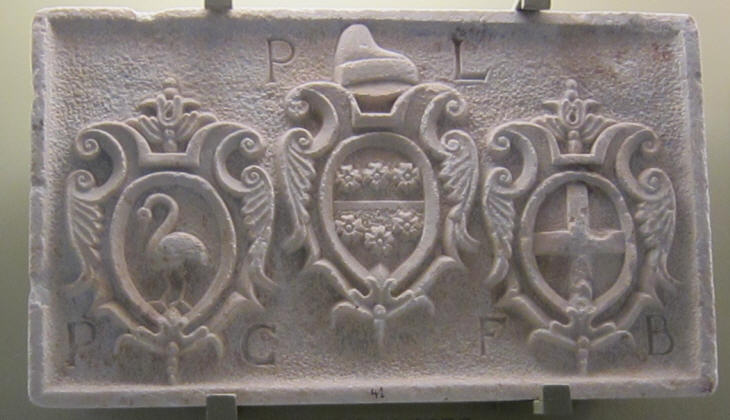
The highst power belong to the venetians (nobili veneti, feudati, "ευγενέστατοι άρχοντες και εκλαμπρότατοι αφέντες"), who were the new-comers and catholics and passed their titles hereditary (see - Historical Museum of Iraklion (Candia): coats of arms of
local Venetian magistrates at the sides of that of Doge Pietro Loredan
(1567-70)). The greek nobility was subordinated, but according to the legend it derived from 12 archontopoules sent by the Byzantine emperor to Crete under"kyr Phoka" . Cretan Greek nobility considered the Byzantine emperors to be the only legitimate source of power, which is reflecte for example in mentioning the Byzantine rulers in the dedicatory inscriptions in the churches built during the Venetocratia.
City dwellers, who were not nobles, were called citizens or
bourgeois (cittadini, burgenses). This class consisted of civil servants and
professionals. To the lower social rank belonged the people of the cities and
the countryside (plebe, populari or populani, villani or contadini). The
villagers were divided into unwritten (agrafi), freedmen (franchi) and paroikoi
(villani parici), working on the public or private land. Villagers paid taxes
(akrosicho, kapniko) and was forced to execute supplementary taxes in goods
such as kaniskia. Unlike them the "tsitadinoi" were free from the
taxes in nature. They had the obligation of military service, paying little tax
and giving accommodation to the foreign mercenaries serving in Crete. The
heaviest natural tax was working for galleys. Many times those who were appointed to
this works were forced to flee to the mountains to avoid it or to sell their property
to pay for replacements. Most Cretans belonged to the class of paroikoi.
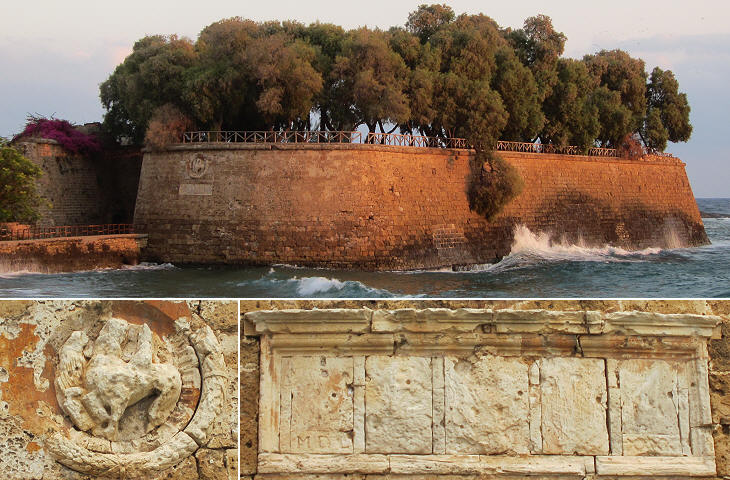 The interests of the Italian Republic
were focused mainly on the beneficial geographical location of the island on the crossroads
of Mideterranean sea-routes, and therefore the majority of the Venetians inhabitated the sea-side towns and lands (see - Bastione
Sabbionara of Candia and a winged lion and erased 1590 coats of arms of the Venetian
officers who promoted the construction of the bastion).
The interests of the Italian Republic
were focused mainly on the beneficial geographical location of the island on the crossroads
of Mideterranean sea-routes, and therefore the majority of the Venetians inhabitated the sea-side towns and lands (see - Bastione
Sabbionara of Candia and a winged lion and erased 1590 coats of arms of the Venetian
officers who promoted the construction of the bastion).
Dowries
were inherited according to juxta usum Graecorum. Shared
memory of Byzantium was used by local archontes as a propaganda tool strengthening their prestige, increasing their influence and formed strong bonds with the
population
According
to catholic priest and traveller Christoforo Buenodelmonti (1415), the archontes
had important roles and were represented as having received their power from
time of Byzantine appointment, these were several families, who were
intermarried, lived separately from the Venetians, used Greek, had Greek titles.
The rural areas were predominantly Greek (rura Romeorum) and an archon was
their only connection to the Venetian authorities.
In this circumstances, the life of the local rural Greecs was changing slowly and preserved continuity with the Byzantine epoch.

In 1283 on Crete the biggest revolution of the Cretan
aristocracy against the Venetians began and it was led by powerful archon of
Mylopotamos(see the photo) Alexios Kallergis. He tried to compel the Venetians to cede to him
privileges and to recognize the independence of this territory. He knew very
well that the independence of Crete was impossible and the union with Byzantium
also impossible. He secured the support of many noble families, paroikoi and
the clergy and began to make small-war attacks (guerilla), which exhausted the
Venetian forces. He quickly became a master of Western Crete and for ten years
he followed the same tactic. At the same time Venetians and Genoese broke out. Both,
the Genoese and the Emperor Andronikos II sought help of Kallergis. So, Kallergis
decided it was time to pose his demands to the Venetians. So he turned to
capitulation which resulted into the agreement of 1299. With this the Venetians
recognized the ruling position of Kallergis in exchange for the oath of loyalty
and obedience to the Venetian state. Kallergis returned his land and even
received some more. The Republic satisfied all his demands: he could keep
horses, release paroikoi, move freely in the cities and fortresses and to
accept kaniskia. Kallergis acquire the right to manage the state monasteries and
that of of the Latin Patriarchate and the dioceses Mylopotamo. He might install
in the area of Arios a Greek bishop. Cretans were entitled to go out of Crete
to be ordained as priests, deacons and their children, if they were paroikoi, were
not "diakratimenoi paroikoi." The treaty with Venice of Allexio
Kalergis was beneficial to all Cretans, lords, clergy and paroikoi. The 1381
Venice bestowed the privilege usually given to the Venetian nobility to Alexios’
son, Georgios Kallergis.

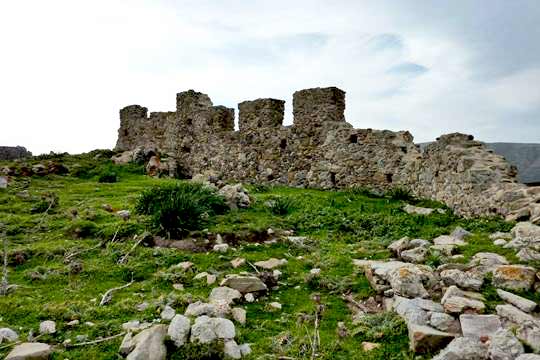
What was so special about this Cretan lady? Almost nothing, except the fact that one can read her last will dictated to the notary on 9th February of 1331. So, 10 years past since the death of her mighty father, and now feeling herself ill, she decided to take care about the postmortem arrangements "seeing dedath approaching". So, she wrote her will in Latin, or more precisely, the notary was venetian, and therefore the will was in Latin.
Agnes bequeaths to her husband Jacobos Cornaro most of her dowry and all other movable and
immovable property. Some other sums went to churches and more distnt relatives, including two sisters. The balance sum of splits in churches, the monastery of
Sinai and various relatives.
Her parents were buried in St. John church in Mylopotamou and she bequeathed 30 heperpyra to bishop Makarios (episcopus Graecorum), Itemdimitto episcopatui Milopotamensi ubi sunt sepulti mei
parentes et mortui mei
Agnes didn't live long after writing her will. In 1333 protopapas Costas Vergitsis (Κώστας Βεργίτης ) gives a receipt to Agnes' husband assuring him
that he collected money from the testament and that they ought to be spent for executing the will of the deceased Agnes at the church of Virgin of the village Kato Kastri in order to comemorate her.
Bibliography:
Maltezou, Chryssa. “Byzantine 'Consuetudines' in Venetian
Crete,” Dumbarton Oaks Papers 49 (1995): 269–280
Μαλτέζου, Χρύσα Α., "Η Κρήτη στη διάρκεια της περιόδου της
βενετοκρατίας (1211-1669)," in: Κρήτη: Ιστορία και Πολιτισμός, ed. Ν. Μ.
Παναγιωτάκης, εκδοτική φροντίδα «Βικελαία Δημοτική Βιβλιοθήκη», Vol. 2 [Σύνδεσμος
Τοπικών Ενώσεων Δήμων και Κοινοτήτων Κρήτης] (Crete: 1988): 105-161
http://www.kallergis.info/
http://kallergides.blogspot.hu/
McKee, Sally. Wills from Late Medieval Venetian Crete, 1312-1420 (Dumbarton Oaks, 1998), vols. 1-3.
McKee, Sally. Uncommon Dominion: Venetian Crete and the Myth of Ethnic Purity (University
of Pennsylvania Press, 2010)


